Static vs Fan-Cooled Deli Counters: Which Serve-Over Case Fits Your Store?
Static cooling keeps unwrapped deli food moist; fan cooling holds temperature evenly through busy service. Here is how to decide, with real model sizes and temperature ranges.
Export Sales Engineer
If your counter displays unwrapped food sold by weight (braised meat, salads, cooked dishes, fresh cuts), start with static cooling. It keeps the product surface moist for longer. If the counter is long, busy and reloaded many times a day, or holds products in trays and packs, choose fan cooling. It holds temperature evenly from end to end and recovers quickly after every restock.
That is the short answer. The rest of this guide explains why, shows where each type goes wrong, and lists the real sizes and temperature ranges you can order.
How the two cooling methods work
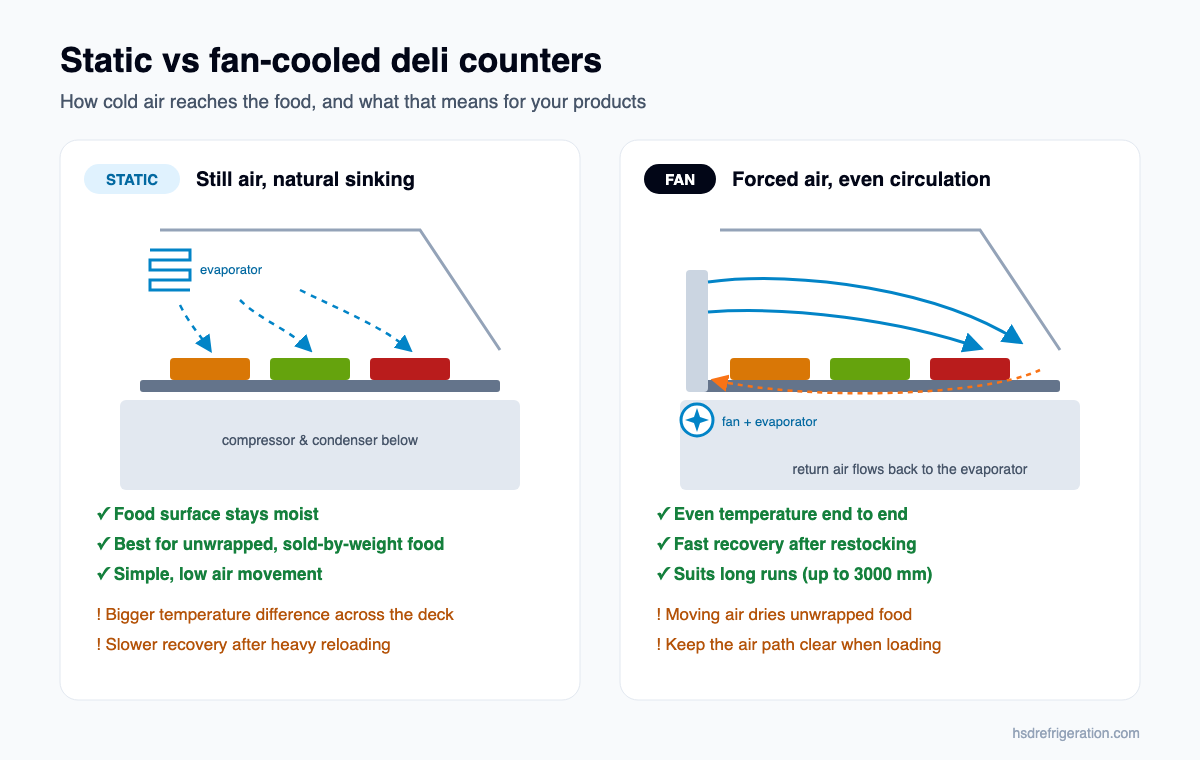
A static (direct-cooled) counter has its evaporator under or behind the display deck. Cold air sinks naturally onto the food, with no fan pushing it. Because the air barely moves, little moisture is pulled off the product surface.
A fan-cooled counter uses a fan to push air across the evaporator and out through a discharge slot, usually at the rear of the deck. The cold air then circulates over the food. Moving air transfers heat much faster, so the cabinet pulls down quickly and keeps every section at a similar temperature. The trade-off is that moving air also carries moisture away.
Neither method is better in general. Each one solves a different problem.
When static cooling is the right choice
Choose static cooling when product appearance through the day matters more than anything else.
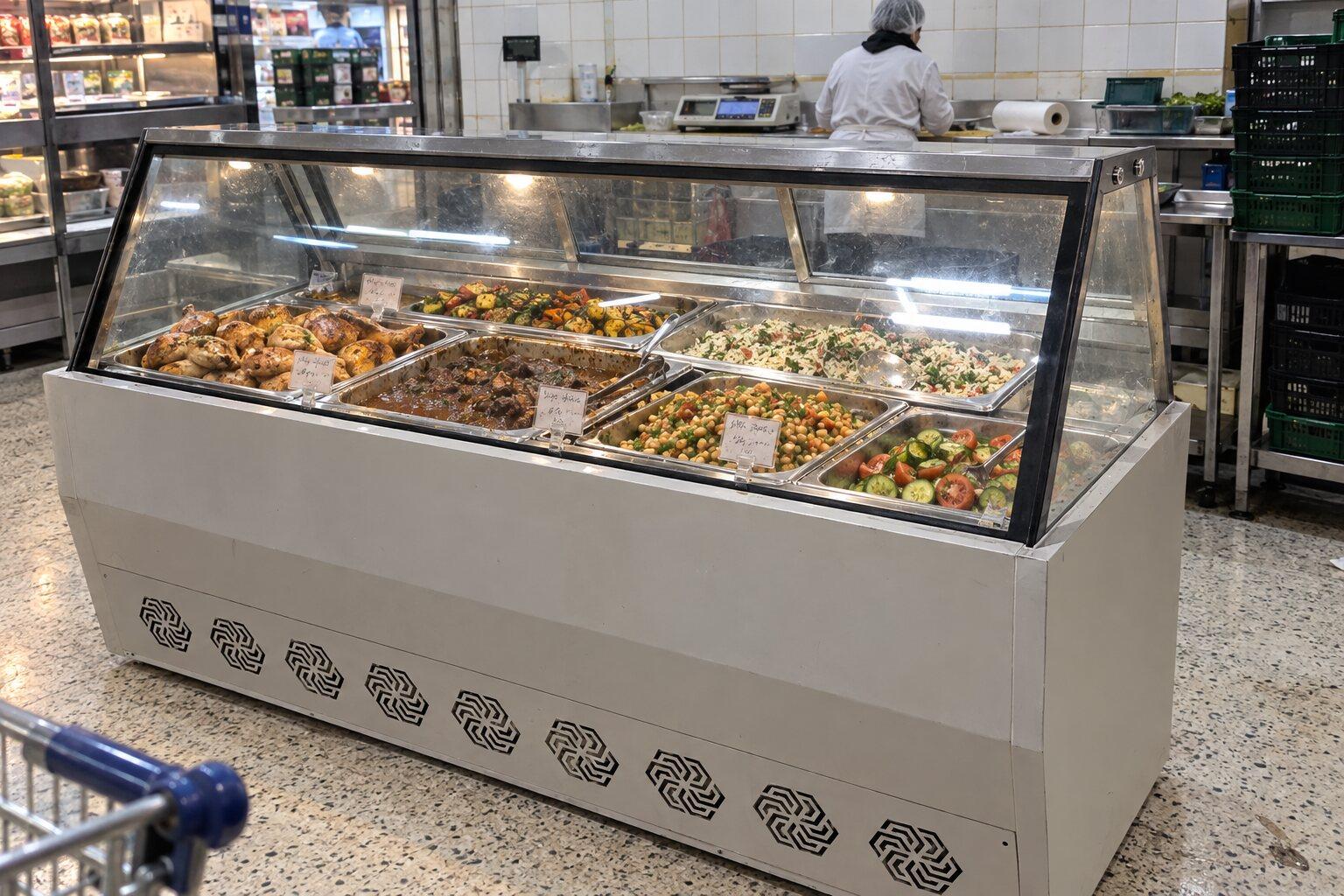
- Unwrapped cooked food and braised meat. Sauced and braised products lose their gloss and form a dry skin when air blows across them for hours. In a static case the surface stays moist, so the food looks as fresh at 6 pm as at 10 am.
- Salads and cold dishes in GN pans. Cut vegetables wilt more slowly in still air.
- Smaller shops with steady, moderate traffic. A deli that loads the counter in the morning and sells through the day gains more from moisture retention than from fast recovery.
Our Straight Glass Static-Cooled Deli Counter is a typical example. It holds +2°C to +8°C on a perforated stainless steel deck, comes in 1200, 1500 and 1800 mm lengths, and is served from rear sliding glass doors. If you need frozen storage in the same footprint, the Straight Glass Static Dual-Zone Deli Counter adds a storage section below −18°C under the +2°C to +8°C display.
What to watch out for
- Temperature varies more across the deck. Without forced air, the area next to the evaporator runs colder than the front corners. Put the most sensitive items in the coldest zone and check with a probe thermometer during the first week.
- Slower recovery. After a big reload with warm product, a static case takes longer to come back to temperature. Load food that has been pre-chilled in the back-room cold store, not food straight from the kitchen.
- Frost and defrost routine. Static evaporators collect frost over time. Ask how defrost works on the model you choose. We can configure the defrost method to suit your store's routine.
When fan cooling is the right choice
Choose fan cooling when stable temperature under heavy use matters most.
- Long counter runs. Forced air reaches the far end of the deck evenly. You can see this in our own range: static deli counters top out at about 1800 to 2000 mm, while fan-cooled models such as the Fan-Cooled Straight Glass Deli Counter (1500, 2000 and 2500 mm) and the Four-Side Glass Fan-Cooled Butcher Counter (up to 3000 mm) are built for long runs.
- High-turnover supermarket service lines. When staff open the case and reload trays dozens of times per shift, fast recovery protects food safety.
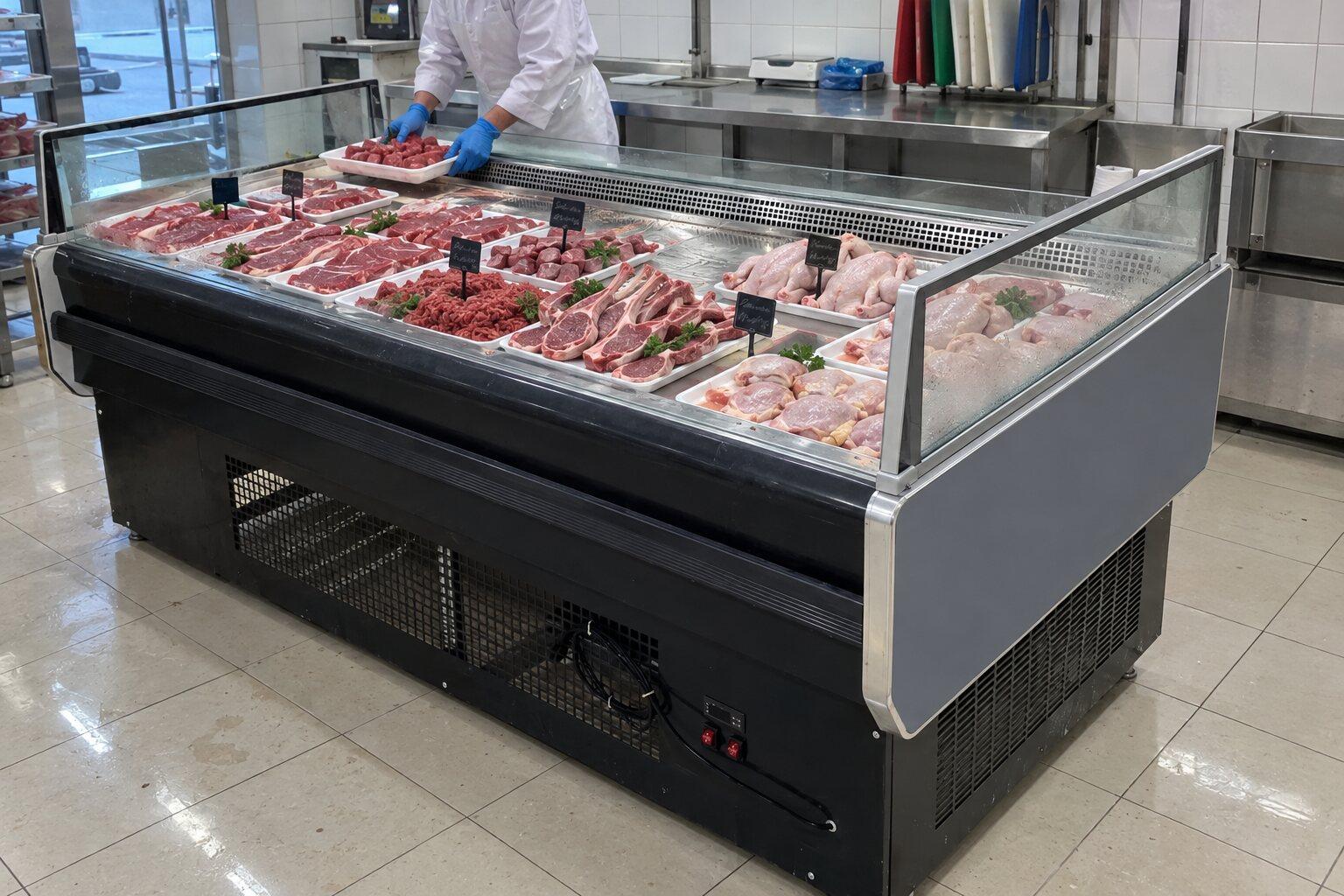
- Fresh meat on an open deck. Fresh meat needs a tight −2°C to +2°C band. Holding that band across an open, flat stainless steel deck takes even airflow, which is why the four-side glass butcher counter uses a long rear discharge slot to spread cold air across the whole surface.
- Packaged or covered products. Film-wrapped trays and lidded containers do not dry out, so fan cooling has no real downside for them.
What to watch out for
- Surface drying of unwrapped food. If you put braised meat in a fan-cooled case, cover the trays during slow hours or rotate stock faster.
- Do not block the air path. Over-stacked trays, or price cards pushed into the discharge slot, break the airflow and create warm spots. Show staff where the load line is.
- Drafts in the store. An air-conditioning outlet blowing straight at the counter disturbs the cold air pattern. Check the ceiling diffusers before you fix the counter position.
Dual-zone counters: two temperatures in one case
Many stores do not need to choose one cooling type for the whole line. Dual-zone models split the case into two temperature zones:
- Curved Glass Static Dual-Zone Deli Counter: static, +2°C to +8°C and −2°C to +2°C.
- Fan-Cooled Curved Glass Dual-Zone Deli Counter: fan, +2°C to +8°C and −2°C to +2°C, 1500 to 3000 mm.
- Static-Cooled Dual-Zone Butcher Counter: static, −2°C to +2°C fresh and below −18°C frozen.
- Fan-Cooled Dual-Zone Butcher Counter: fan, −2°C to +2°C fresh and 0°C to +4°C prep.
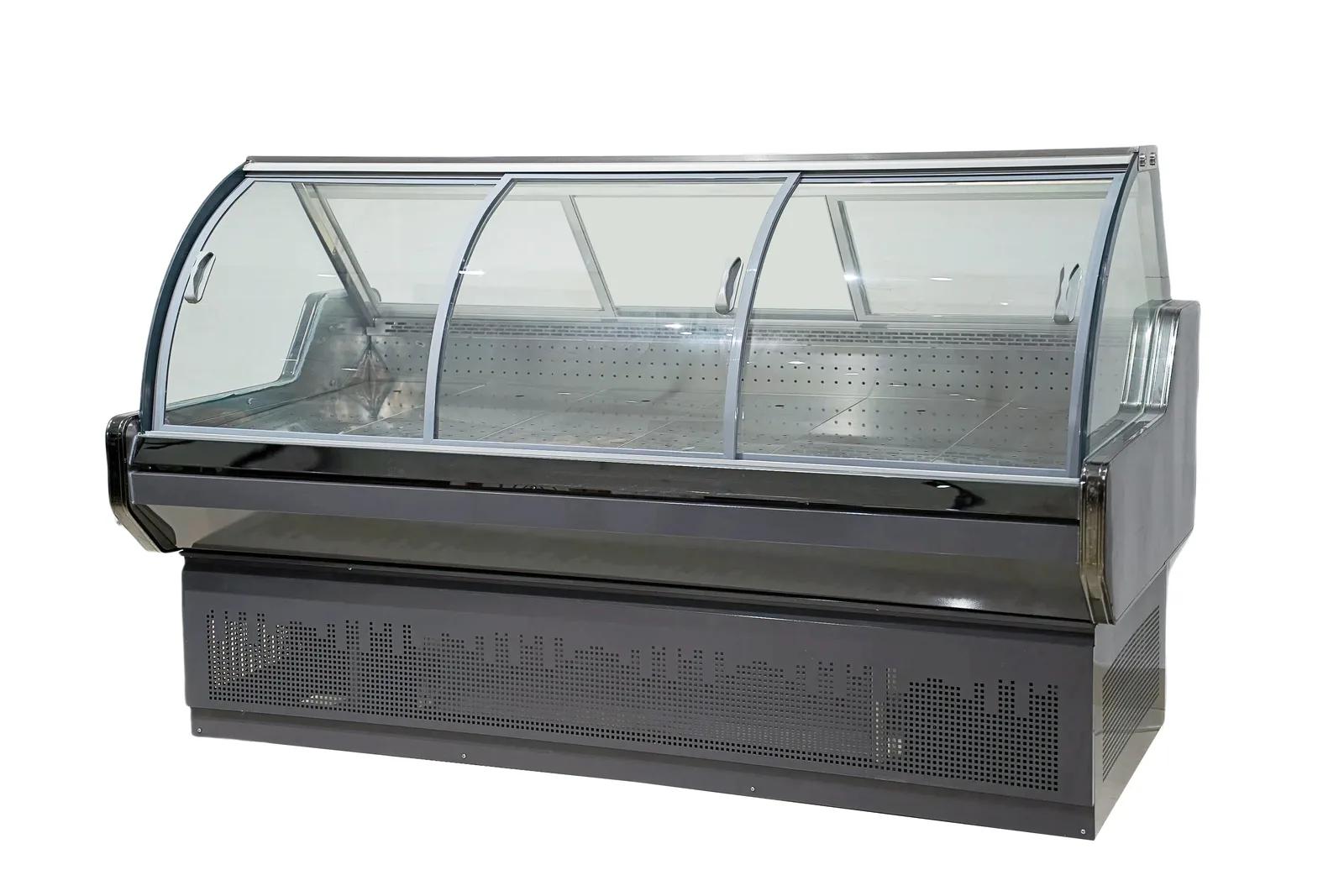
A common supermarket setup is a static dual-zone counter for braised and cooked food next to a fan-cooled butcher counter for fresh meat. Each product gets the cooling it needs, and the line still reads as one run. You can compare every model on our serve-over counters page.
Five questions to answer before you order
- Is the food wrapped or unwrapped? Unwrapped and sold by weight: lean static. Wrapped or in covered trays: fan is fine.
- How long is the run? Above about 2 m, fan cooling holds temperature more evenly.
- How many reloads per day? Frequent reloads: fan, for faster recovery.
- How hot is the store? In hot stores with weak air conditioning, every counter works harder. Give your supplier the real room temperature and humidity.
- What power supply does the site have? Our serve-over counters are available in 220–240V/50Hz, 220V/60Hz and 110–120V/60Hz. Confirm the voltage and frequency at the site before ordering.
FAQ
Is a static deli counter cheaper to run than a fan-cooled one?
Not automatically. The fan motor adds a small load, but a fan-cooled case reaches temperature faster and the compressor cycles differently. Real running cost depends on case length, store temperature and how often the case is opened. Send us the models you are comparing and we will share the rated power of each.
Can I display fresh meat in a static counter?
Yes. Our static dual-zone butcher counter holds −2°C to +2°C in the fresh section, and still air slows colour loss on exposed meat. For long open decks, fan cooling gives more even temperature.
What refrigerant do these counters use?
R290 as standard. On many models R404A is available for non-EU markets where service technicians are more familiar with it.
What is the lead time?
Samples ship in 7 to 15 days. Volume orders ship 25 to 35 days after deposit, and different models can be mixed in one container.
Not sure which counter fits your layout?
Send us your store plan, the products you sell and your local power supply. Our engineers will recommend models and lengths. Request a quote.